
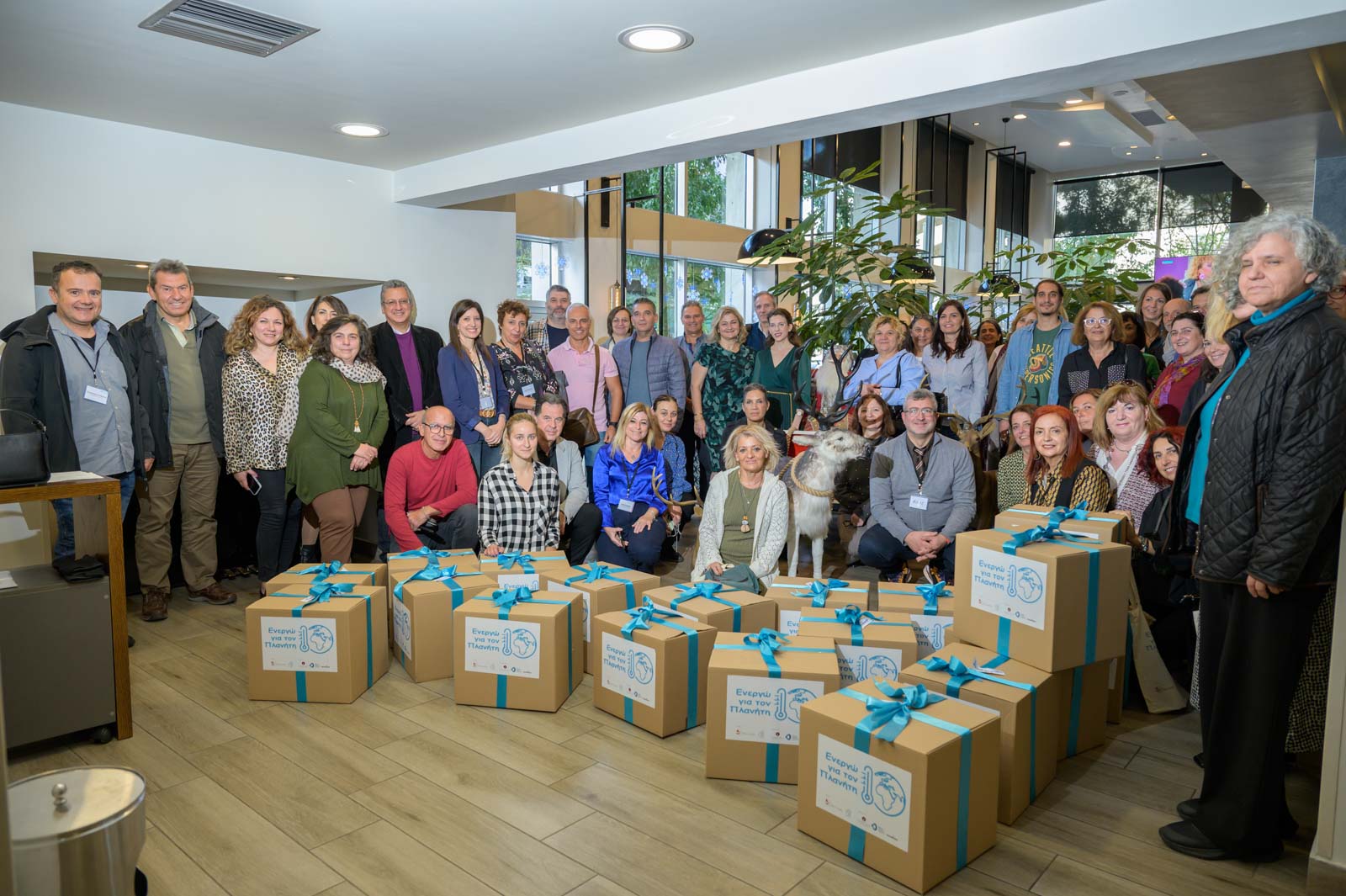
Training for Coordinators and Teachers of “I Act for the Planet” – 24–26 November 2023
From 24 to 26 November 2023, a training programme for coordinators and teachers participating in the Lambrakis Foundation’s new programme “I Act for the Planet” took place at The Stanley Hotel in Athens. The programme is addressed to teachers of all specialities and introduces climate change to students from kindergarten through upper secondary school from the perspectives of natural sciences and citizenship, using technology and the Internet of Things (IoT) and developing citizen-science practices.
In the programme’s pilot phase, 110 teachers from different disciplines and 28 schools in 16 prefectures of Greece were participating.
“I Act for the Planet” was designed and is implemented by the Lambrakis Foundation within the activities of Initiative ’21, with funding from the Public BenefitJohn S. Latsis Foundation, the Athanasios C. Martinos Foundation and Accenture Greece.
Initiative ’21 was established on the occasion of the 200th anniversary of the beginning of the Greek Revolution and is the result of systematic cooperation among Greek public-benefit, cultural and scientific foundations and the National Bank of Greece. It continues its activities with an emphasis on Climate Change and the Environment.
Within this framework, “I Act for the Planet” aims to help students from kindergarten through upper secondary school investigate and learn in depth about climate change, its causes and its consequences in different areas of life at global, national and local level. Through discovery-based scientific approaches, children and young people learn about ways to act to mitigate the rapidly developing situation or adapt in order to manage it. They identify international, European and national policy commitments and guidance on combating climate change and propose solutions beginning with their own everyday lives at school, at home and in the community. They formulate specific, realistic and feasible proposals and create action plans, drawing on the expertise of scientists and social partners. They then invite target groups — such as classmates, young people in their prefecture, families, businesses, the public, local authorities and government — to take action. Their plans include clear objectives, steps and provisions for measuring the impact of their initiatives, followed by evaluation of the results.
During the three-day training, Vivi Anthopoulou, Director General of the Lambrakis Foundation and the programme’s creator and designer, presented the content, structure and methodology of “I Act for the Planet”. Athanasios Katsis, former Rector of the University of the Peloponnese and Professor of Statistics in Educational Research, presented the methodology for the programme’s external evaluation, which includes measurements among children before and after participation. The event was also attended by Ioannis Manos, Coordinator of Initiative ’21 and Adviser to the National Bank of Greece; Eva Lianou, Director General of the John S. Latsis Public Benefit Foundation; Valia Fragkou, Executive Director of the Athanasios C. Martinos Foundation; Agamemnon Kakanelis, Managing Director of Accenture Greece; and Petros Angelopoulos, Regional Director of Primary and Secondary Education for the Ionian Islands.
A total of 125 teachers and programme coordinators, 40 of whom participated remotely, received evidence-based information about climate change, its causes and consequences and took part in experiential activities from the perspective of students. They were also trained in the use of the technological equipment provided to them.
More specifically, Thaleia Mavrakou, physicist and researcher at the National and Kapodistrian University of Athens, gave a clear presentation explaining what climate change is, its causes and consequences, and the myths surrounding it. Dr Dimitrios Sotiropoulos, physicist and scientific associate of the European University Cyprus, used presentations and activities throughout the three days to show how we can interpret the world — and especially climate change — through science, technology and the Internet of Things. He trained teachers to use part of the equipment together with Dr Giorgos Souvatzoglou, physicist and R&D manager for educational programmes at STEM Education, and Christina Tzoumerkioti, Head of Kindergarten at STEM Education. Vaso Serepa, physicist and teacher; Alexandra Tsigkou, Environmental Education Officer at the Directorate of Primary Education of Western Attica; and Polychronitsa Ioannidou, kindergarten teacher, undertook the training of secondary-, primary- and kindergarten-level teachers respectively. The programme’s 16 regional coordinators developed activities with teachers during the training. Finally, Maria Xanthopoulou, project manager of “I Act for the Planet”, presented the asynchronous training and advisory-support platform and outlined the next steps.
At the end of an intensive three days, the prevailing feeling in the packed plenary hall was optimism: optimism for students with stronger abilities to understand and use natural science and technology, greater knowledge of climate change, a stronger sense of responsibility and a willingness to take action that creates a positive impact for the survival of the planet.