
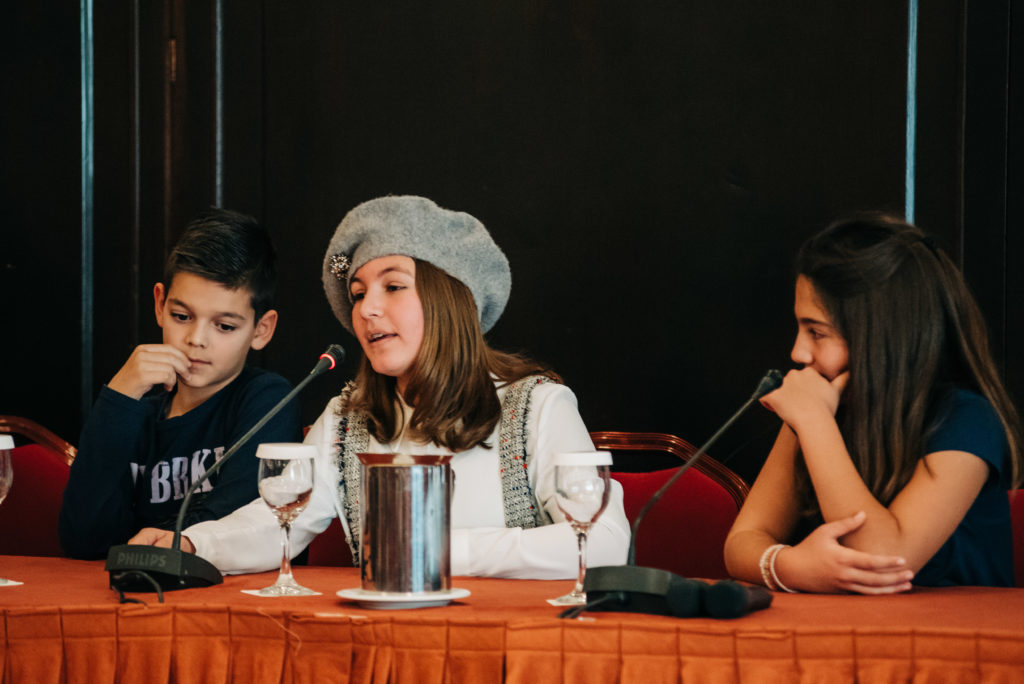
Student Debates on 1821: “Historical Debate Activities”
Within Initiative 1821–2021, the Lambrakis Foundation designed an educational programme in cooperation with the Association for History Education in Greece (AHEG/OIEE) and the Hellenic Institute of Rhetorical and Communication Studies (IRESE) for implementation in primary and secondary schools. The programme was approved by the Ministry of Education (Ref. F.1/DN/56179/171336/D7).
The programme focuses on in-depth examination of historical questions connected with the school narrative of the 1821 Revolution — a field in which academic history and public history meet. It provides for a series of organised “Historical Debate Activities” in schools across Greece. The debates are based on historical research evidence, multiperspectival sources and scholarly interpretations and make use of rhetoric-in-education techniques. Initially, teachers develop model debates; students who observe them then prepare and participate in similar activities themselves.
The programme was also linked to the international conference “The Greek Revolution, Education and Collective Memory – Transformations of School and Public History”, organised on 18–19 February 2021 within Initiative 1821–2021 by the Lambrakis Foundation, Panteion University and the Association for History Education in Greece. Findings from the conference were used to enrich the themes of the historical debates, while sample student debate activities were presented during the conference.
The programme aims to cultivate students’ historical and critical thinking and democratic awareness. By working with historical texts and with information circulating in public discourse and online about the 1821 Revolution, students learn to construct coherent oral arguments about both historical and contemporary reality. The programme promotes experiential and inquiry-based learning, the construction of historical argument and democratic dialogue.
Its methodology develops empathy, critical thinking, argumentation, dialogue, analytical and synthetic thinking, communication and research skills, as well as the ability to critically receive, use and create knowledge and information in traditional and contemporary media. It also strengthens goal-setting, decision-making, organisation, time management, active listening and reflection.
Because of the special circumstances created by the pandemic, the programme was implemented online during the 2020–21 school year. Interested teachers could apply until 24 January 2021 and then receive the necessary training and remote advisory support.
Teachers were selected in order of application and informed during January. A workshop-style training seminar was held on 31 January 2021 and participation was required in order to implement the programme at school. After completing the seminar, teachers implemented the programme independently, using the instructions provided and the material available on the programme platform.
View the programme approval by the Ministry of Education here.