
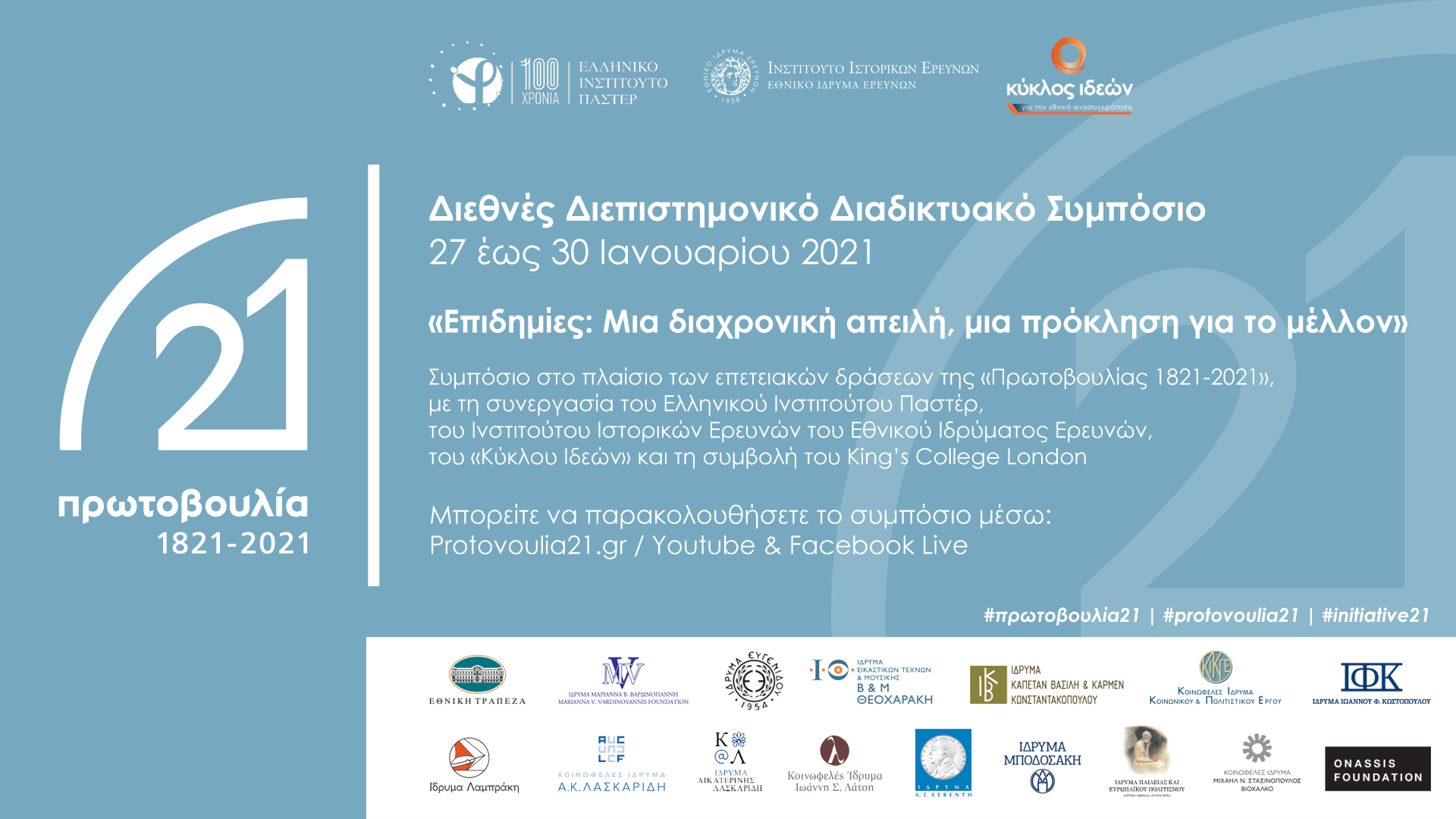
“Epidemics: A Timeless Threat, a Challenge for the Future” – Symposium
“Epidemics: A Timeless Threat, a Challenge for the Future” was an international interdisciplinary symposium organised within the anniversary programme of Initiative 1821–2021 for the bicentenary of the Greek Revolution, in cooperation with the Hellenic Pasteur Institute, the National Hellenic Research Foundation – Institute of Historical Research, the Circle of Ideas and with the contribution of King’s College London.
The symposium was scheduled for 28, 29 and 30 January 2021 and was structured around four thematic pillars. The historical pillar examined how the present pandemic turns our attention to the past and to societies’ historical experience of epidemics. The psychological pillar explored the effects of a pandemic on mental and physical health, historically and in the future. The legal pillar considered the functioning of liberal democracy and the protection of human rights in conditions of public-health emergency. The medical pillar focused on the biological challenge itself, the scientific response, prospects for effective vaccines and the advances expected by the time of the symposium.
If public-health conditions did not allow the event to take place in a physical venue with an audience, the organisers had made provision for it to be held online. The same approach applied to the wider programme of Initiative 1821–2021. The Initiative’s programme had been presented at the Athens Concert Hall the previous January in the presence of then President of the Hellenic Republic Prokopis Pavlopoulos and Prime Minister Kyriakos Mitsotakis, with a fuller announcement of events in Greece and abroad to follow.
Initiative 1821–2021 brought together the National Bank of Greece, the Eugenides Foundation, the B. & M. Theocharakis Foundation for the Fine Arts and Music, the Captain Vassilis & Carmen Constantakopoulos Foundation, KIKPE, the Ioannis F. Kostopoulos Foundation, the Lambrakis Foundation, the Athanasios C. Laskaridis Charitable Foundation, the Aikaterini Laskaridis Foundation, the John S. Latsis Public Benefit Foundation, the A. G. Leventis Foundation, the Bodossaki Foundation, the Foundation for Education and European Culture, the Michael N. Stasinopoulos – VIOHALCO Public Benefit Foundation and the Onassis Foundation. The Initiative was coordinated by Ioannis Manos, adviser to the National Bank of Greece.
The rationale of the symposium
Initiative 1821–2021 was created through cooperation among public-benefit, cultural and scientific foundations and the National Bank of Greece in preparation for the 200th anniversary of the 1821 Revolution. The COVID-19 pandemic coincided with the final phase of planning and implementing the bicentenary programme. It therefore became essential to incorporate the pandemic into the reflection and thematic discussions developed through the anniversary events.
From the outset, the Initiative’s guiding principle — “History as inspiration for the future” — assumed a dialogue between the past, the problems of the present and the prospects of the future. COVID-19 is another manifestation of the epidemics societies have encountered throughout history. Epidemics raise fundamental questions across time: private and public attitudes towards illness and death; solidarity and humanity; the role and limits of science, research and technology; citizens’ rights and obligations; and the urgent need to design policies for confronting such crises in the present and future.
An international symposium bringing together researchers from different disciplines and methodological traditions, with the common goal of understanding and responding to pandemics, was fully consistent with the spirit of unity, cooperation and forward-looking reflection on which Initiative 1821–2021 was founded.
The symposium was intended to produce material on the long-term medical, historical, legal, social and psychological consequences of epidemics. Within Initiative 1821–2021, the Lambrakis Foundation undertook to adapt this material pedagogically so that it could be made available to secondary-school teachers. With appropriate advisory support, teachers would introduce it to students and invite them to research, discuss, debate and take positions on the symposium’s major questions, taking expert views into account.
Programme – Historical pillar
In cooperation with the National Hellenic Research Foundation – Institute of Historical Research: “Epidemics and Societies of the Past”. Keynote speaker: Professor John R. McNeill, Department of History, Georgetown University, Washington DC. The discussion panel included Josep Lluis Barona Vilar (Universitat de València), Katerina Gardikas (National and Kapodistrian University of Athens), Christos Lynteris (University of St Andrews), Maria Mandyla-Kousouni, Efi Poulakou-Rebelakou (National and Kapodistrian University of Athens), Giannis Stogiannidis (University of West Attica) and Kostas Tsiamis (National and Kapodistrian University of Athens).
Programme – Legal pillar
In cooperation with the Circle of Ideas: “Pandemic, Fundamental Rights and Democracy”. The session was coordinated by Professor Evangelos Venizelos, former Deputy Prime Minister and Minister of Foreign Affairs. Participants included Professor Giorgos Gerapetritis, Minister of State; Professor Linos-Alexandre Sicilianos, former President of the European Court of Human Rights; Athanasios Rantos, Minister of State; Professor Lilian Mitrou, member of the National Council for Radio and Television; Christina Akrivopoulou, PhD in Constitutional Law; and Ioannis Manos, lawyer, adviser to the National Bank of Greece and coordinator of Initiative 1821–2021.
Programme – Psychological pillar
With the contribution of King’s College London and the coordination of Emeritus Professor Elias Kouvelas of the University of Patras Medical School: “Mental Health & Pandemic: Experiences from COVID-19”. Keynote speaker: Professor Sir Simon Wessely, Regius Professor of Psychological Medicine, King’s College London. The session was coordinated by Nikandros Bouras, Emeritus Professor of Psychiatry, King’s College London. Contributions addressed the perception of time during COVID-19, physical contact during the epidemic, effects on sleep quality, the effects of isolation on children and adolescents, and prevention and treatment of mental-health problems during a pandemic, with speakers including Argyro Vatakis, Katerina Fotopoulou, Dimitrios Dikeos, Eleni Lazaratou and Dimitris Ploumpidis.
Programme – Medical pillar
In cooperation with the Hellenic Pasteur Institute and with the contribution of Fotini Stylianopoulou, President of the Institute’s Board, and Emeritus Professor Elias Kouvelas: “The Great Return of Epidemics: COVID-19”. The session was coordinated by paediatrician and epidemiologist Takis Panagiotopoulos. Panel participants included Carolina Akinosoglou, Charalambos Gogos, Theodoros Lytras, Andreas Mentis, Angelos Pefanis and Sotirios Tsiodras. Additional plenary lectures were planned with internationally recognised epidemiology and biomedical researchers, including Manolis Kogevinas and George N. Pavlakis.
The symposium was part of a wider programme intended to use the bicentenary not only as a commemoration of the past, but also as an opportunity for informed public dialogue about the challenges shaping Greece and the wider world.